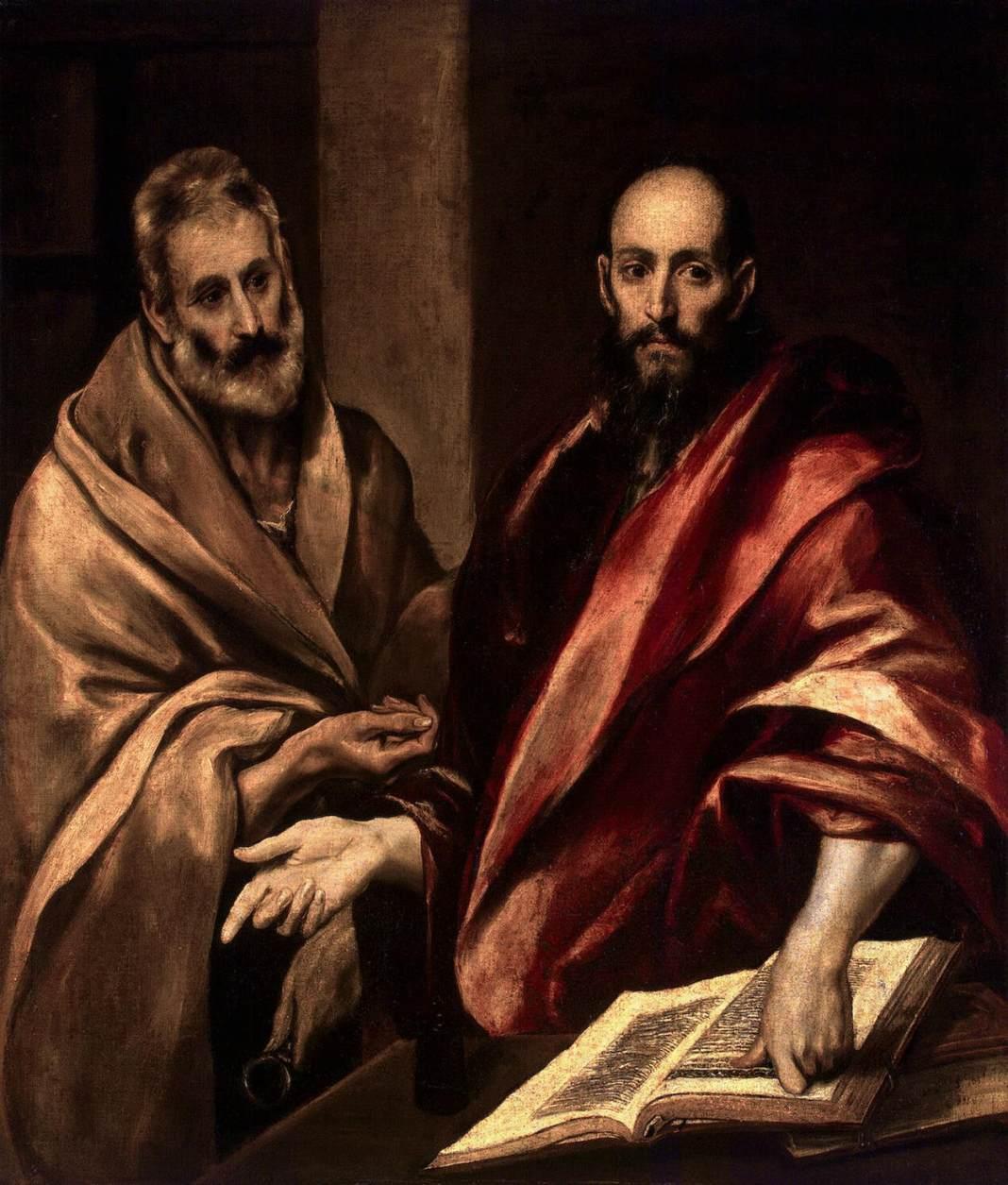
Image: El Greco, The Apostles Peter and Paul (1587-1592), State Hermitage Museum. Public domain, via Wikimedia Commons. (source)
Et ego dico tibi, quia tu es Petrus, et super hanc petram ædificábo Ecclésiam meam, et portæ ínferi non prævalébunt advérsus eam.
Matthew 16:18
And I say to thee: That thou art Peter; and upon this rock I will build my church, and the gates of hell shall not prevail against it.
About Today
On November 18 the 1962 calendar keeps the Dedication of the Basilicas of the Holy Apostles Peter and Paul, a feast of the third class, with white vestments. It honors the two great churches of Rome raised over the graves of the Princes of the Apostles, and so it is above all a feast of St. Peter and St. Paul themselves. The Mass is that of the Dedication of a Church, which begins with the words of Jacob: “Terrible is this place: it is the house of God, and the gate of heaven.”
Their Lives
Simon, son of John (or Jona), was a fisherman of Bethsaida on the Sea of Galilee who lived at Capharnaum with his family. His brother Andrew brought him to Jesus, who looked upon him and gave him a new name, Cephas, which means Rock, or Peter. He left his nets to follow the Lord and became the first among the Twelve. At Caesarea Philippi he confessed, “Thou art Christ, the Son of the living God,” and Our Lord promised to build His Church upon him and to give him the keys of the kingdom of heaven.
Peter was ardent and sometimes rash. He walked on the water and then began to sink; he swore he would never abandon his Master and then denied Him three times on the night of the Passion. Yet he wept bitterly for his fall, and after the Resurrection the risen Christ asked him three times, “Lovest thou Me?” and three times entrusted to him the care of His flock: “Feed My lambs, feed My sheep.” On Pentecost Peter preached to the crowds in Jerusalem, and about three thousand were baptized. He guided the young Church, received the first Gentile convert, the centurion Cornelius, and, according to ancient tradition, after a time at Antioch came to Rome, where he governed the Church as its first bishop.
Saul was born at Tarsus in Cilicia, a Jew of the tribe of Benjamin and a Roman citizen. He was trained as a Pharisee at the feet of Gamaliel in Jerusalem and at first fiercely persecuted the followers of Jesus; he stood by approving when St. Stephen was stoned. On the road to Damascus a light from heaven struck him down, and he heard the voice: “Saul, Saul, why persecutest thou Me?” Blinded for three days, he was baptized by Ananias, and the persecutor became the Apostle of the Gentiles, known to us as Paul.
For some thirty years Paul carried the Gospel across Asia Minor, Macedonia and Greece, founding churches and writing the letters that fill so much of the New Testament. He was scourged, stoned, shipwrecked and imprisoned, yet he could write, “I can do all things in Him who strengtheneth me.” Arrested in Jerusalem, he appealed to Caesar and was brought as a prisoner to Rome, where he still preached the kingdom of God to all who came to him.
Both Apostles gave their lives in Rome under the emperor Nero. Tradition holds that Peter, counting himself unworthy to die as his Lord had died, was crucified head downward near the Vatican hill, and that Paul, as a Roman citizen, was beheaded on the road to Ostia. Christians buried them close to the places of their martyrdom and honored their tombs from the first centuries.
After the Church received her freedom, the emperor Constantine built a great basilica over St. Peter’s grave on the Vatican and another over St. Paul’s on the Ostian Way; tradition says Pope St. Sylvester consecrated them in the fourth century. St. Paul’s was later greatly enlarged, and after a fire in 1823 it was rebuilt and consecrated anew by Pope Pius IX in 1854. Old St. Peter’s gave way to the present basilica, which Pope Urban VIII consecrated on November 18, 1626. To this day pilgrims from every nation come to pray at these two tombs.
Patronage and Sacred Art
St. Peter is honored as the first Pope and the patron of the Popes, and of fishermen. In art he is most often shown holding the keys of the kingdom of heaven, sometimes with an upside-down cross recalling his martyrdom, or with a rooster recalling his denial and repentance. St. Paul is the patron of missionaries and preachers. He is usually shown with a sword, the instrument of his martyrdom, and a book or scroll for his epistles. The two are very often painted together, as in El Greco’s picture above, as the twin founders of the Church of Rome.
A Lesson for Today
Peter fell and rose again; Paul was a persecutor who became an apostle. Neither was holy by his own strength, but by grace and by faithful love of Christ. Their tombs remind us that the Church is built on the witness of real men who gave everything, and that our own churches are houses of God and gates of heaven, where we too are called to pray with reverence.
Collect
Latin
Deus, qui nobis per síngulos annos huius sancti templi tui consecratiónis réparas diem, et sacris semper mystériis repræséntas incólumes: exáudi preces pópuli tui, et præsta; ut quisquis hoc templum benefícia petitúrus ingréditur, cuncta se impetrásse lætétur. Per Dóminum nostrum Iesum Christum, Fílium tuum, qui tecum vivit et regnat in unitáte Spíritus Sancti, Deus, per ómnia sǽcula sæculórum. Amen.
English
O God, who dost every year renew for us the day of the consecration of this Thy holy temple, and dost ever bring us again in safety to Thy sacred mysteries: hear the prayers of Thy people, and grant that whosoever entereth this temple to ask Thy blessings may rejoice in having obtained all that he asked. Through our Lord Jesus Christ, Thy Son, who liveth and reigneth with Thee in the unity of the Holy Ghost, God, world without end. Amen.
Sancti Apostoli Petre et Paule, intercédite pro nobis.
Holy Apostles Peter and Paul, intercede for us.